
Pumps under the house, hydrants in the yard, tankless heaters that need power and a crawl space nobody checks: what an empty island house needs before winter, drawn from our own calls on South Whidbey
Winterizing a Whidbey second home comes down to four things: shut the water off where you can, keep heat and power on for anything that needs them, drain whatever sits outside the warm part of the house, and arrange for someone to look in after a freeze. The details depend on the pump, water heater and crawl space.
Our fall plumbing checklist covers the basics for any house: heat on low, main off, pressure off the lines, hoses off the bibs. A house that sits empty on the island for months has more to think about, and the jobs below are where we see it.
1. Pumps that live under the house
Island houses often rely on pumps that a city house never has: a well pump, a pressure tank, an ejector, or a booster to bring weak pressure up to something usable. Each one needs a winter plan.
In May 2026 Willie and Logan worked at a South Whidbey house between Freeland and Langley whose owner lives off the island, with nobody home. The pressure was so low that the front hose bib would not run, and the laundry tap read 5 psi. They mounted a Grundfos Scala2 booster pump in the crawl space, primed it, bled the air out and brought the laundry tap up to 41 psi, then set the pump to 3 bar and left its paperwork beside it. Before they packed up they insulated the lines in the crawl space.
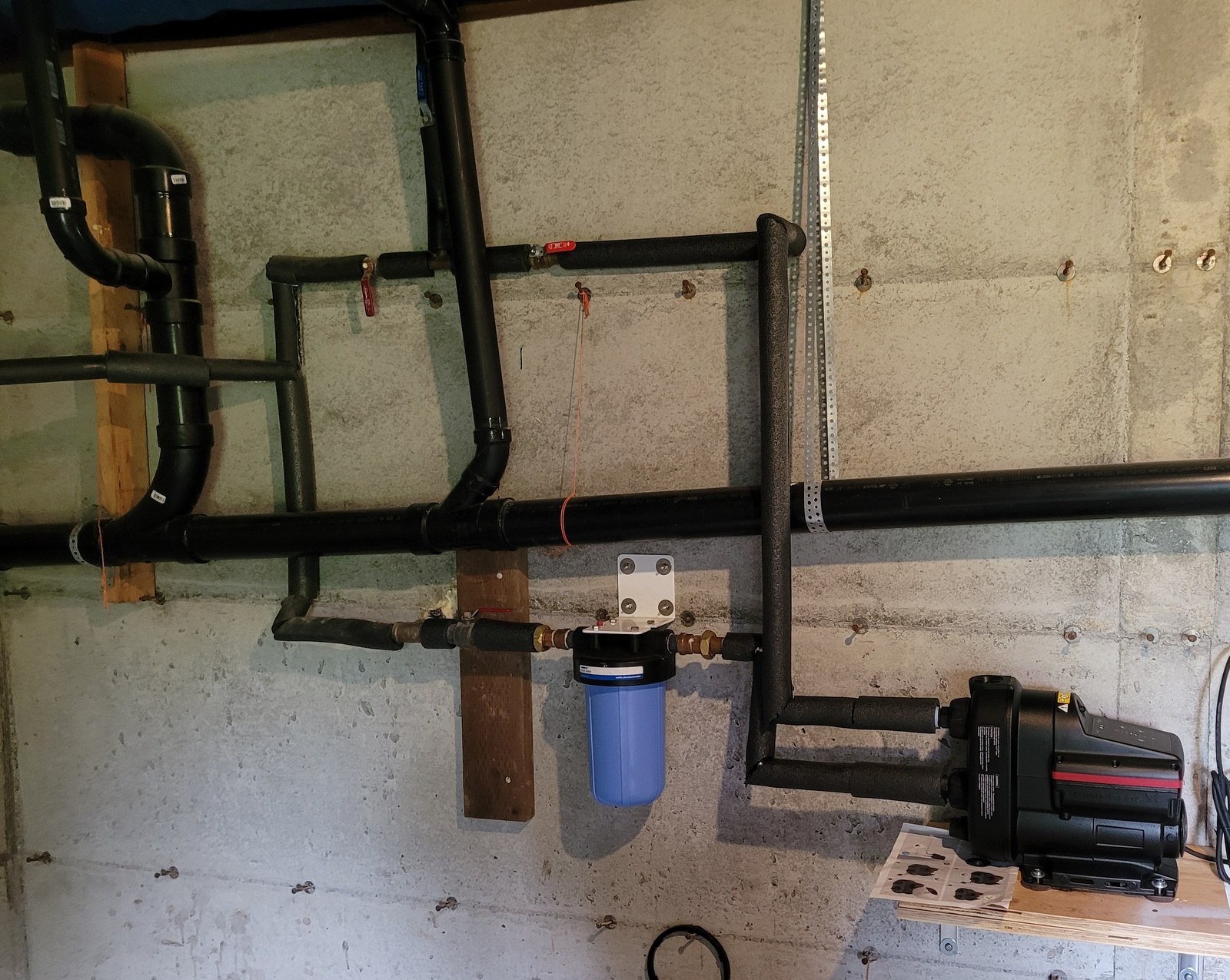
A pump in a crawl space is only as safe as the space around it. Grundfos says that in winter a system exposed to frost risk must be completely empty, so if your crawl space can freeze, have the pump and its lines drained before you go. If the space stays warm, check that the insulation is intact and that nothing has knocked it loose.
2. Tankless water heaters need power to protect themselves
Plenty of island houses heat water with a tankless unit, and a tankless is the appliance most likely to be hurt by a well-meant shutdown. Navien, whose heaters we service on the island, says its freeze protection requires electricity. If the power fails in freezing weather the protection cannot work, and if you will disconnect the power or the gas for an extended period, the heater should be drained. Navien also says freeze damage is not covered by its warranty.
So decide before you leave. If the power stays on all winter, the heater can look after itself as long as the power does. If you switch the power off, have the heater drained. In May 2026, at a house north of Freeland, Willie and Logan did the annual maintenance and descale on a Navien while they were there for other work, which is the right time to ask how to drain your own model.
3. Yard hydrants and hose bibs
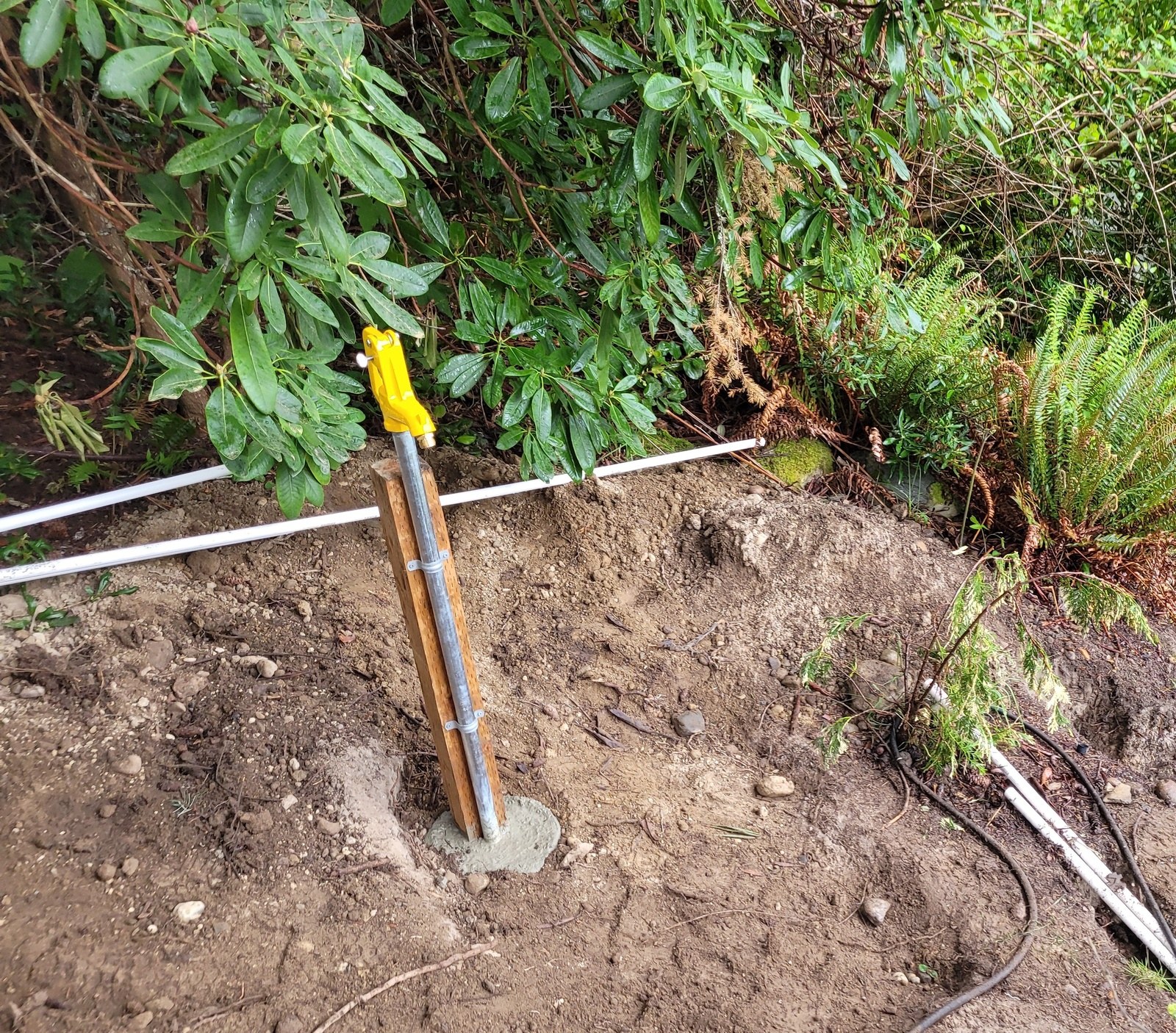
A frost-free yard hydrant shuts off below the ground and lets the water left in its riser drain out of a small hole at the bottom every time it closes, which is why it needs a bed of gravel to drain into. When Willie and Logan set a new hydrant north of Freeland in May 2026, they bedded it in the gravel the manufacturer specifies and topped it with concrete to hold it firm, then pressurized it and checked for leaks before the hole was filled in. On the same visit they replaced a failed hose bib on the back of the house, working from the crawl space.
Before you leave, take every hose off, both the hydrant and the bibs. A hose left on traps water where the fixture is meant to drain it, and that water is what splits a bib or a hydrant in a hard freeze.
4. Look at the crawl space before you lock up
An empty house can take on water for weeks without anyone noticing, and not all of it is plumbing. A month after the hydrant job, Chase went back to the same house north of Freeland and found more than five inches of standing water across the crawl space. He checked the new hose bib and the drain lines, then watched the water meter for about a minute without it moving, which ruled out a leak in the supply lines, and passed along the name of a water-damage company to deal with the water itself.
A look under the house before you leave, and again after heavy rain if someone can manage it, tells you which kind of problem you have while it is still small.
5. Leave a way in and a number that answers
Our crews can work in a house nobody is in, as long as we know how to get in and how to reach you. The booster pump went in with the owner away, and when it was done the crew sent the invoice and left a voicemail explaining the pressure setting. Leave a way in, a phone number that answers and the location of the main shutoff, and ask a neighbor or a caretaker to look in after any hard freeze.
Second Home Winterizing Questions
Does a tankless water heater freeze if the power goes out while I am away?
It can. Navien, for one, says its freeze protection needs electricity, so in a power failure during freezing weather the protection stops working and the unit should be drained. If you plan to switch off the power or the gas for the winter, have the heater drained before you go. Navien's warranty does not cover freeze damage.
My booster pump is in the crawl space. Does it need anything before winter?
It needs to stay above freezing or be drained. Grundfos says a system exposed to frost risk must be completely empty in winter, so if the crawl space can freeze, have the pump and its lines drained. If the space stays warm, check the insulation on the lines, like the foam Willie and Logan fitted at a South Whidbey house.
I found water standing in my crawl space. Does that mean a pipe has burst?
Not necessarily. Rain and groundwater fill crawl spaces too. Turn off every fixture and watch the water meter, and if it does not move, the supply lines are not leaking. That is how Chase ruled out plumbing at a house north of Freeland in June 2026, where more than five inches of water stood under the floor.
Our Recommendation
Book a walk-through in October or November, on one of our island days, before you close the house for the season. We will find and test the shutoff, check the pump, the water heater, the hydrant and the crawl space, and tell you what to leave on and what to drain. A short visit in the fall costs far less than a spring spent drying out a crawl space or replacing a split heater.
Closing Up an Island House
Call the office, tell us where on the island the house is and when you plan to leave, and we will fit the visit into a day we are already on Whidbey.
Call 425-374-3909 · Request a Quote
Related: the fall plumbing checklist · Whidbey Island plumbing questions, answered · plumbing in Freeland · plumbing in Langley · plumbing in Clinton · plumbing in Coupeville · hose bib repair and replacement · tankless water heaters
Stollwerck Plumbing & Sewer · Mukilteo, WA · WA License #STOLLPL780CJ · One-year guarantee on every job