Whose pipe it is, which valve shuts it off and who needs to know, from a year of calls in Everett, Mukilteo and Lynnwood
In a shared building, the plumbing question is rarely just what broke. It is also whose pipe it is, which valve controls it and who has to agree before a wall or ceiling opens. Getting those three answers first is most of what makes a repair in a condo, a townhome association or a small apartment building go smoothly.
We do this work for condominium associations and their managers, for owners of single units, and for landlords with a few doors in an older building, mostly in Everett, Mukilteo and Lynnwood. Here is what a year of those calls has shown us, job by job.
1. Whose pipe is it?
Under Washington's condominium statutes, unless the declaration says otherwise, a pipe that crosses a unit's boundary and serves only that unit is a limited common element allocated to that unit, while a pipe serving more than one unit is a common element. Finished surfaces such as drywall, paint and flooring are part of the unit itself.
Those defaults come from RCW 64.34.204, and from RCW 64.90.210 for communities under the newer act, and each association's declaration can change them. The declaration, not the plumber, decides who pays for which repair. What we can tell you is exactly which kind of pipe failed: the drain under one unit's shower, a supply line serving one unit, or a line that serves the whole building.
2. The valve behind the wall
In September 2026 Chase replaced a water heater in a Mukilteo condo and, while he was there, tightened the packing nut on the unit's old main gate valve, which had a very small drip. Less than two weeks later the valve itself had failed. When Willie and Logan opened the wall behind it in early October, the job turned out bigger than anyone expected: the valve sat in a space too tight for press fittings, so every joint would have to be soldered, and replacing it meant draining the whole building.
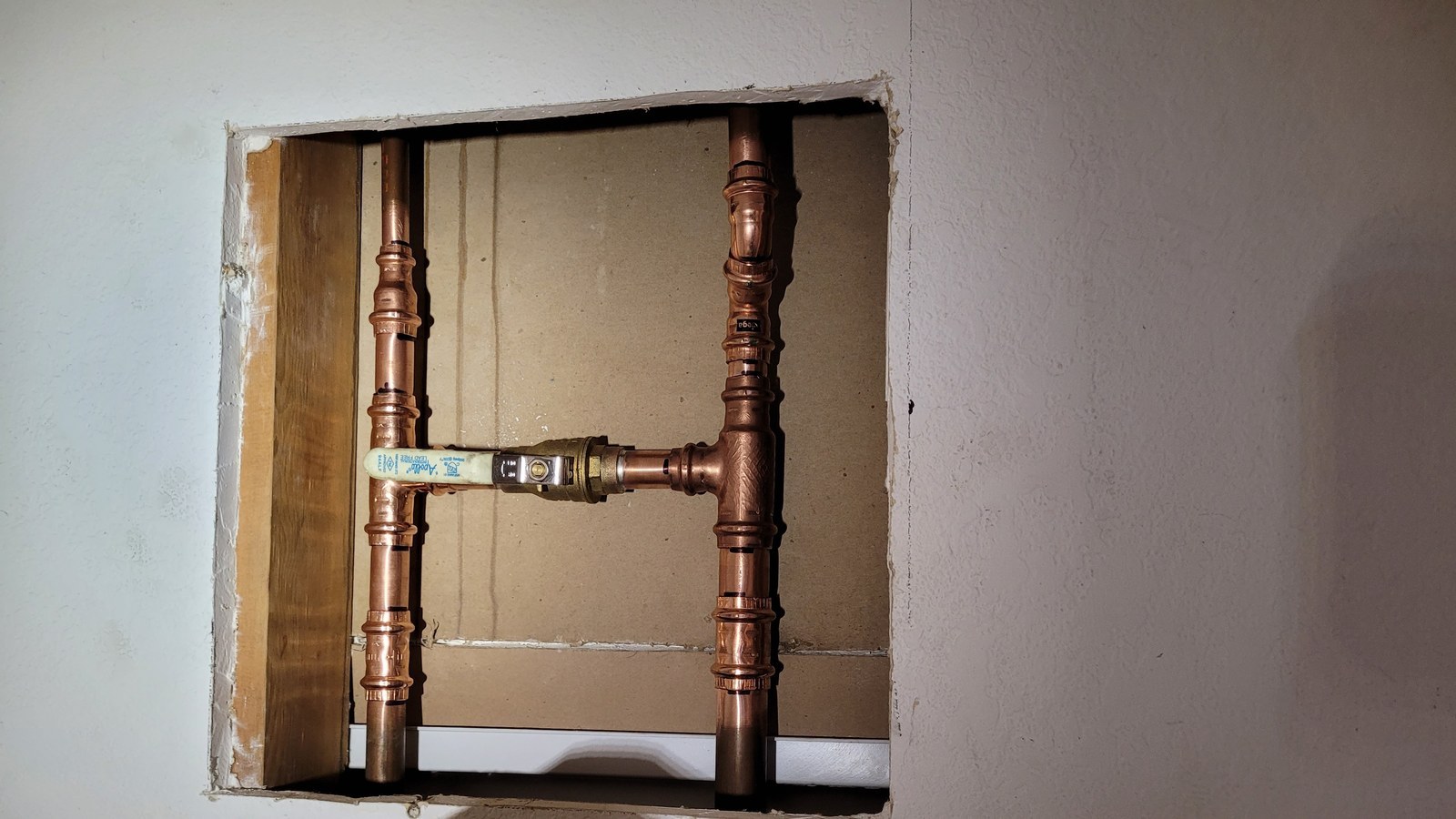
The owner contacted the association, and once it had been told, they came back on October 15. They opened the wall for a fourteen-inch panel, drained the building, cut out the old valve and installed a new ball valve, recessed so the access panel would fit over it. They confirmed water and a running hose bib in the unit, then brought the system up to full pressure and checked for leaks once more.
If your unit's shutoff is old, ask the association now whether replacing it would mean draining the building. It is much easier to plan that shutdown than to discover it.
3. The leak that shows up in the unit below
Condo leaks are often found from underneath. At a Lynnwood condominium whose manager sends us work orders, Logan and Justin opened the ceiling of a unit in August 2025 and found the upstairs shower drain leaking where its nut had loosened from below. They removed an earlier repair and rebuilt the drain with a new brass no-caulk shower drain. Then they plugged it, filled the shower pan above while they cleaned up, checked that it held, drained and dried the pan, and asked the people upstairs to keep the shower off for 24 hours.
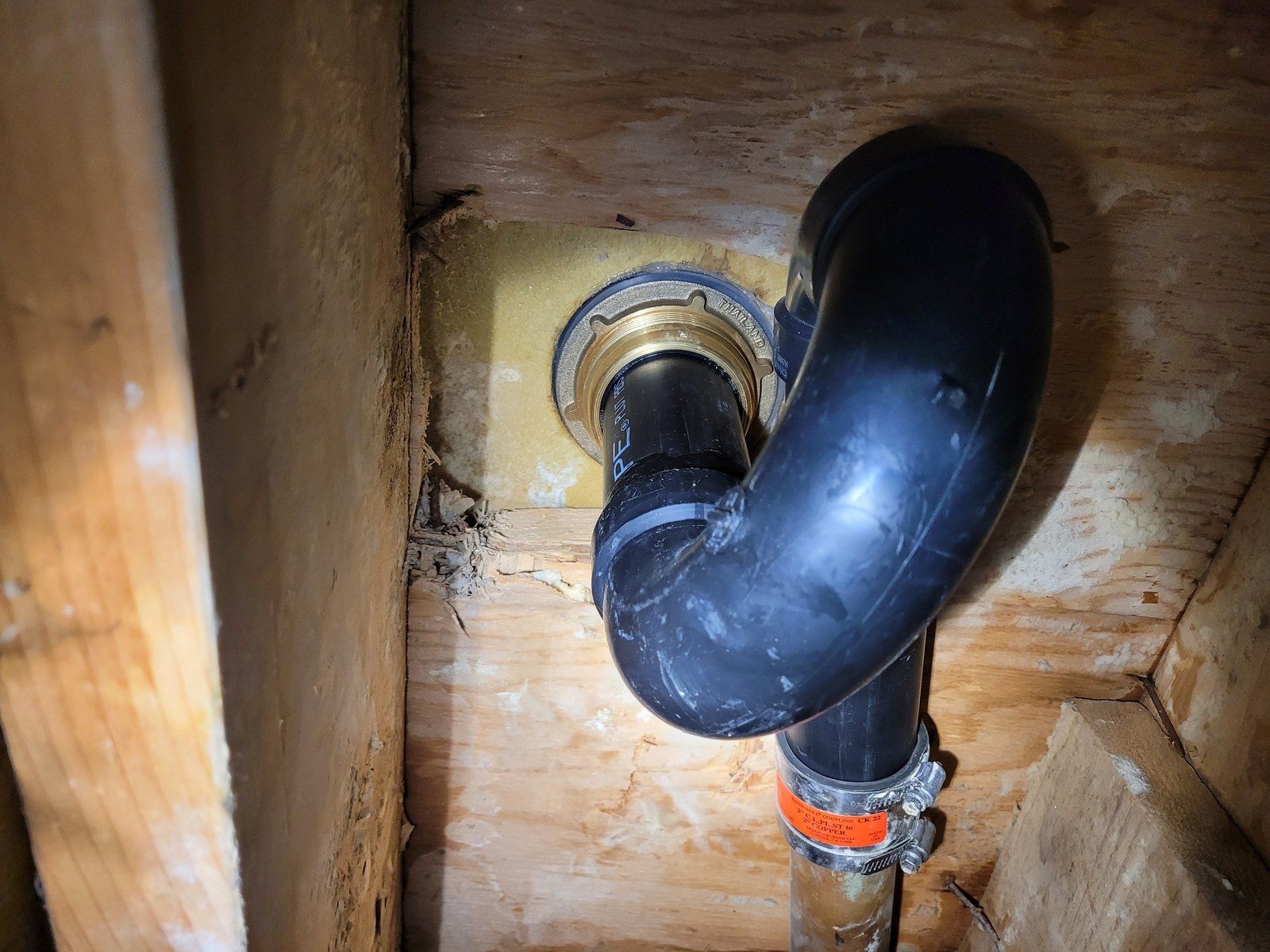
Days later, at the same complex, a leak above the tub in another unit's hall bathroom had no visible source in the bathroom upstairs. With the ceiling open below and water running above, the drip appeared over the tub's overflow, so they pulled the upstairs shower trim, opened the wall around the valve and cleared away the spray foam packed around it. The leak was higher than they could see from there. With the upstairs owner's permission they opened the wall from its other side and found two push-fit fittings leaking on the shower riser, then removed the push-fit fittings and the PEX and rebuilt everything from the valve up with press fittings.
4. Not every stain is a pipe
In January 2026 Connor and Logan opened a ceiling under a stain in a third unit at that complex, after calling the manager for approval. The drywall was dry, there was no water line or drain close enough to explain it, and the dryer vent nearby showed no sign of water. Faint staining on the subfloor above pointed to a one-time spill upstairs, and that is what they reported. A clear finding that a stain is not a plumbing leak saves an association from paying for a repair it does not need.
5. When the whole building's water has to come off
Some repairs cannot be isolated to one unit. At the same Lynnwood complex in July 2026, Willie and Chase found two pinhole leaks in about eight inches of the building's one-and-a-quarter-inch copper recirculation line. They shut the whole building off at the main in the basement storage room, turned off the recirculation pump in the boiler room and drained the system through four hose bibs on the side of the building. With the bad section cut out and replaced by two push-fit couplings and a short copper nipple, they repressurized, bled the air out through the hose bibs and checked the repair again with everything back on. A shutdown like that touches every unit, which is why the notice to residents matters as much as the repair itself.
6. Small apartment buildings and handyman plumbing
In June 2026 a leak showing up in one unit of a small apartment building in Everett's Port Gardner neighborhood was coming from the water heater in another unit, and the first visit ended with no answer at that unit's door. Three days later Willie, Chase and Logan replaced the heater, a 19-gallon unit a handyman had put in, with the largest heater that would fit the cabinet, a 28-gallon Bradford White lowboy. The unit's shutoff would not close completely, so at the handyman's request they added a second shutoff on the hot line. They set the new tank in a drain pan and purged the air through the kitchen faucet before turning it on.
When a leak starts in a unit next to the one reporting it, access is the whole job. If we know who has a key before we arrive, the first visit can be the repair.
7. The apartment over the shop
In a mixed-use building, the business and the apartments above it often share one water service. In November 2025 Connor and Logan shut off the water to a building in Pinehurst so they could replace the leaking angle stop for an upstairs apartment's toilet with a new iron-pipe stop on a new brass nipple. They turned the water back on to check it, fitted a retrofit flange into the four-inch cast-iron riser and fastened it to the new floor, then installed a pressure-assist toilet, tested it with several flushes and sealed the base.
8. Townhome associations and winter valves
At an association's townhomes just south of the Everett city limits, one unit's outdoor hose bib has two valves on its line: a ball valve in the house and a small valve in the unit's storage room that is used to winterize it. In August 2025 a resident's suspected leak in that storage room turned out to be the two valves opened in the wrong order. With the storage-room valve closed, Logan pressurized the line, found no leak anywhere at full pressure and got water at the hose bib. A week later he found a real leak in another unit, a failed solder joint above the hose bib's shutoff on a line looped through a kitchen cabinet, and rebuilt that section with a new hose bib.
In a layout like that the order matters every time the outdoor water is turned back on: the storage-room valve has to be closed before the house valve is opened.
Questions Boards and Owners Ask
Can you get to a leak from the unit below?
Often that is the best way in. A ceiling opening under a shower or tub shows which drain or fitting is wet without tearing out tile upstairs, as it did twice at a Lynnwood condominium in 2025. We still need access to the unit above to run its fixtures, test the repair and confirm the leak has stopped.
Can you shut off one unit without draining the building?
Only if the unit has its own shutoff and it still closes. In a Port Gardner apartment in June 2026 the unit's valve would not shut off completely, so we added a second one on the hot line. In a Mukilteo condo this October, the unit's failed valve meant draining the whole building to replace it.
Who should call you, the owner or the association?
Either one, and we will work with both. When a repair is inside a shared wall or will affect other units, we make sure the association knows before anything is opened, as the Mukilteo condo owner arranged in October. That one step often decides whether the repair happens on the first visit or the second.
Our Recommendation
Before anything fails, know three things about your building: where the main shutoff is and whether it closes, whether each unit has a working shutoff of its own, and who can approve opening a wall or ceiling. With those answers in hand, a repair in a shared building can usually happen on the first visit, and a building shutdown can be planned instead of discovered.
For Boards, Managers and Owners
Call the Mukilteo office with the building, the unit and what you are seeing. We will tell you who we need to hear from and which valves we will be looking for.
Call 425-374-3909 · Request a Quote
Related: commercial plumbing · commercial plumbing in Everett · commercial plumbing in Mukilteo · commercial plumbing in Lynnwood · plumbing for property managers · water leak repair · water heater service
Stollwerck Plumbing & Sewer · Mukilteo, WA · WA License #STOLLPL780CJ · One-year guarantee on every job