
What a repair call looks like when the customer is a fire district or a school district, told from three of our own jobs in Snohomish County and on Whidbey Island
When a fire district or a school district hires a plumber in Washington, even a one-fixture repair can be public work, paid at prevailing wage, with a statement of intent and an affidavit filed with Labor & Industries. Here is how that plays out on real calls, from a sewage chamber at a fire district's headquarters to a flushometer at a school in Langley.
1. A service call can be public work too
Prevailing wage is not only for new schools and road projects. Washington's law covers maintenance and repair contracts for public agencies as well as construction, so a call to fix one fixture in a public building can carry the same wage rates and the same filings as a much larger job. The rates are set by trade and by county. We have done small repairs on exactly those terms, from a single flushometer at a school in Langley to a set of pump floats at a fire district's headquarters.
2. The paperwork, in the order it happens
Every contractor on a prevailing-wage job files a Statement of Intent to Pay Prevailing Wages with L&I, ideally as soon as the work is awarded, and L&I has to approve it before the agency can make any payment at all. When the work is finished, the contractor files an Affidavit of Wages Paid, and the agency holds back its final payment, or the retainage on a larger job, until that affidavit is approved too. Small jobs paid in a single payment can sometimes use one combined intent and affidavit form instead, as long as no subcontractors are involved.
In practice that means three things for a facility manager. The plumber should file their own paperwork without being chased for it. The agency's accounts staff will check L&I's records for an approved intent before cutting a check. And an invoice for public work carries an administration line for the filing, which is normal.
3. A fire district's headquarters south of Everett: both sewage pumps down
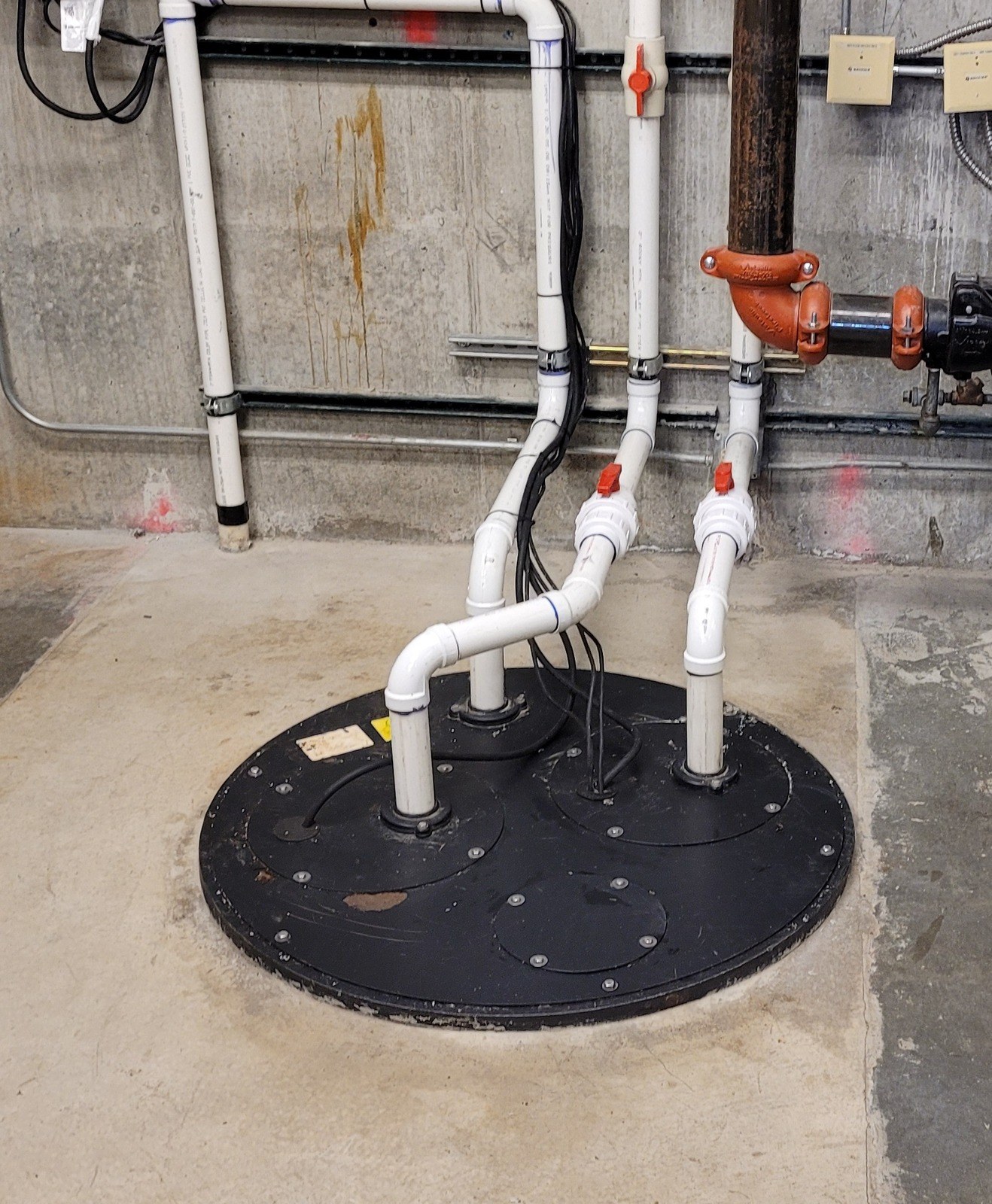
In October 2025 a fire district called us about a sewage chamber that had stopped working at its headquarters building south of Everett, and J.D. went out on the emergency call. Four days later Connor and Logan came back to replace the failed pump and found that the second pump in the duplex chamber had failed as well, which they confirmed by plugging it straight into the wall. The district brought in a pump truck to empty the chamber so the crew could work. With two new Zoeller high-head pumps set in the chamber, they installed new check valves, finished building the discharge lines and wired in a new duplex control panel, then cycled the chamber three times to prove it.
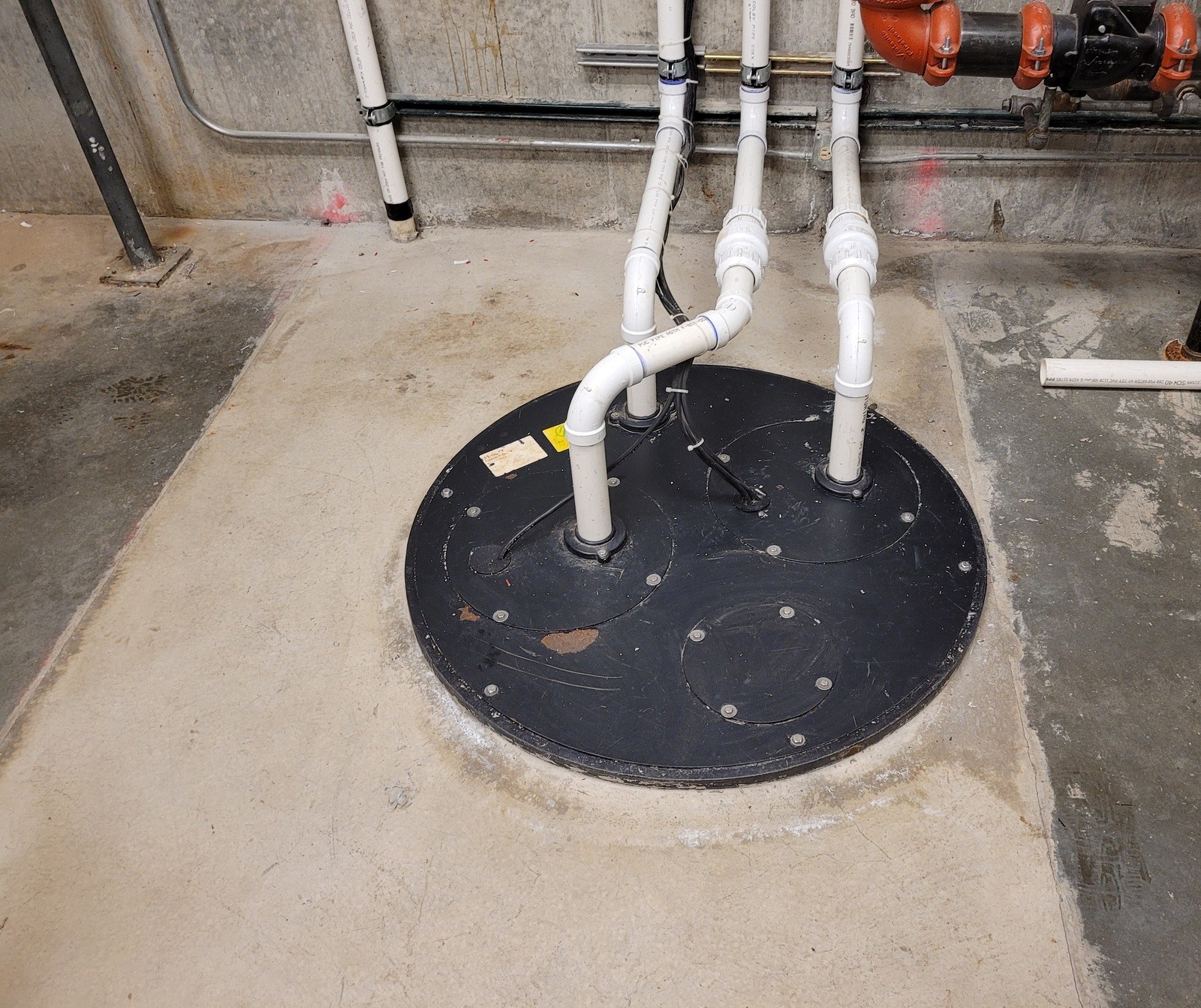
A month later the district's alarm kept coming back within one to three days of being cleared. Connor and Logan pulled the old floats and installed three new ones, in the same order and wired exactly as the electrician had them, adjusted them after the first cycle so nothing in the chamber could interfere with them, and ran five full cycles with no issues. A building that never closes cannot wait for a convenient day, so the job was planned around the building, and the district's own pump truck became part of the plan.
4. A fire station in Lynnwood: a washer that outran its drain
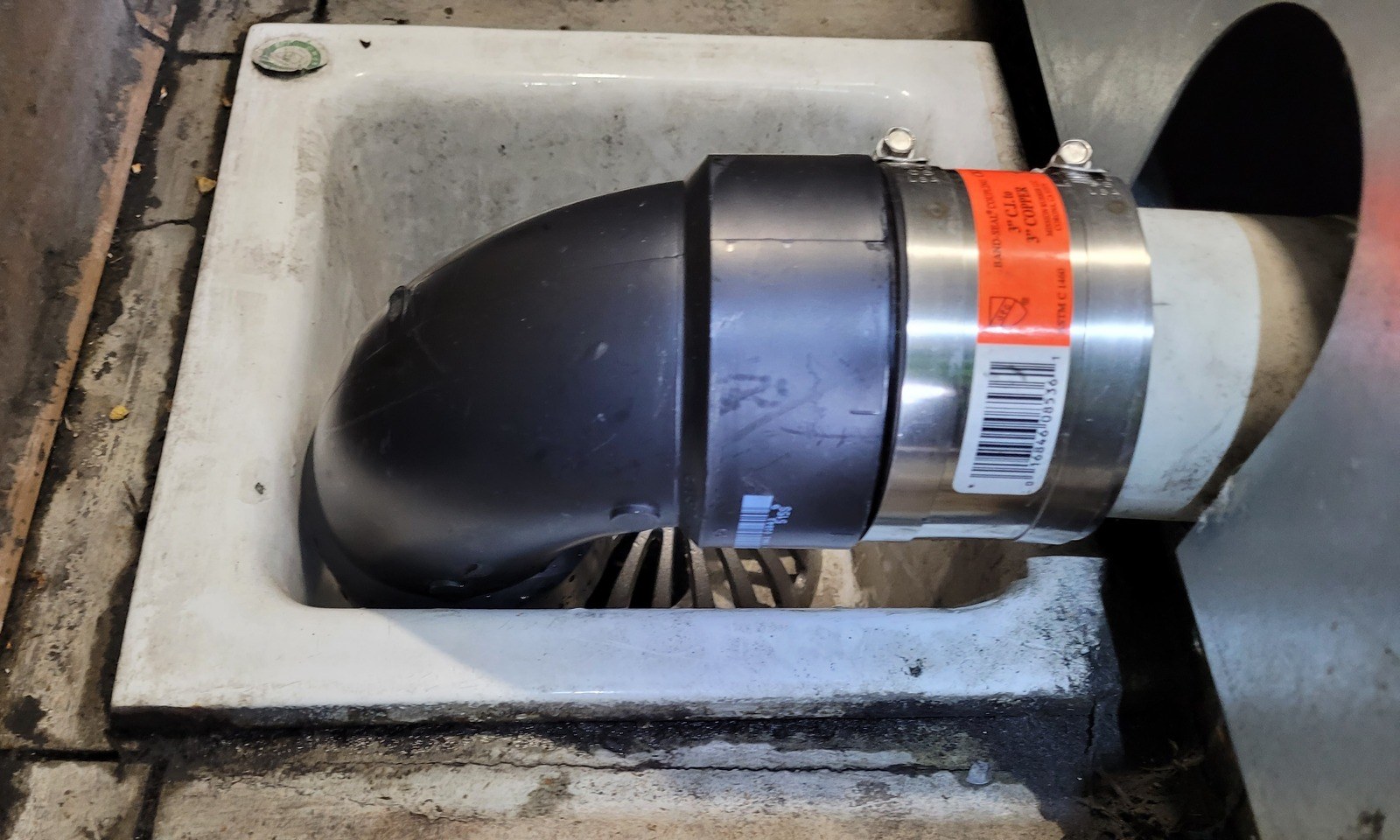
In May 2026 Logan and Willie answered a call at a fire station in Lynnwood where the floor sink behind the extractor that washes the crews' turnout gear kept overflowing. They ran a camera through the drain and found it completely clear. The problem was volume: the machine dumps through a three-inch discharge into a floor sink only about nine inches square, and the first dump overloaded it no matter how the discharge was pointed. They reworked the drain with different offsets and laid out the two lasting fixes, piping the machine directly to drain as its manufacturer intends or fitting a larger floor sink.
5. A public school in Langley: finding the shutoff
In December 2025 Connor and Logan were at a South Whidbey public school in Langley to replace a leaking gasket on a flushometer toilet they had reset after jetting its line. When they loosened the tailpiece, the flushometer shifted as if it were under pressure, and the angle stop below it turned out to have failed, so the fixture could not be isolated at its own valve. Finding another way to shut the water off took the school's staff, the city and the fire department, until the school's staff found a valve near the main building that worked. With the water off, the O-ring and the tailpiece coupling were replaced and the water went back on. Everything worked except that one toilet, whose flushometer had picked up debris and kept running, so it was shut down at its stop and the stall was put out of order. Only afterward did it become clear that the valve they had used shut off the entire campus.
So in January they came back first thing in the morning, shut the water off and drained the building down, rebuilt the angle stop and confirmed it worked, replaced the flushometer cartridge and flushed it several times. Then they walked the building and flushed every toilet and urinal once to make sure water was back everywhere.
6. What a public agency can expect from us
- Licensed plumbers on our own crew, insured above Washington's mandate, which is what public work requires.
- Our own intent and affidavit, filed without anyone having to ask.
- Work planned around operations, whether that means the district's pump truck, an early start before school or a return visit for a shutdown.
- Findings in writing, with photos, so the next person to touch the system knows what is there.
Questions Facility Managers Ask
Does a small repair at a fire station or school really need prevailing wage?
It can. Washington's prevailing wage law covers maintenance and repair contracts for public agencies as well as construction, so a single flushometer or a drain call at a fire station or school may need the wage rates and the L&I filings. Your contracting rules decide which jobs qualify, and we handle our side either way.
Who files the intent and the affidavit, the agency or the plumber?
The plumber does. Each contractor files its own Statement of Intent to Pay Prevailing Wages before payment and its own Affidavit of Wages Paid when the work is done, and L&I approves both. The agency's part is to confirm the approvals in L&I's system before paying, and before releasing final payment or retainage.
Can you work on a building that cannot shut down, like a fire station?
Yes, and most public buildings are like that. We stage the work so the shutdown is as short as possible, schedule it for the quietest hour the building has, and use whatever the agency can bring, which at one fire district's headquarters meant its own pump truck emptying the sewage chamber while we rebuilt it.
Our Recommendation
Find your building shutoffs before you need them. The flushometer at the Langley school was a small repair that turned into a search for a valve, and a plumber can map and tag the shutoffs on a routine visit long before anything fails. If your building has a sewage chamber, have the pumps and floats looked at regularly, because when one pump quits, the other is often close behind.
A Plumber Set Up for Public Work
If you look after a fire station, a school or another public building in Snohomish County or on Whidbey Island, call the office and tell us how your agency handles contracts and access. We will take it from there.
Call 425-374-3909 · Request a Quote
Related: commercial plumbing · commercial plumbing in Everett · commercial plumbing in Lynnwood · commercial plumbing in Langley · commercial plumbing in Shoreline · plumbing for property managers
Stollwerck Plumbing & Sewer · Mukilteo, WA · WA License #STOLLPL780CJ · Insured above state mandates · One-year guarantee