What eighty-year-old steel pipe actually does in Everett's oldest houses, from four jobs on the north end
Galvanized steel pipe fails at its threads, not along its length. In north Everett's early-1900s houses the short threaded nipples between cast-iron fittings, and the stubs behind faucets and hose bibs, rust through first, while the fittings around them look fine. The repair is to cut back to sound metal. The decision is how many times to do it.
1. Why the nipples go first
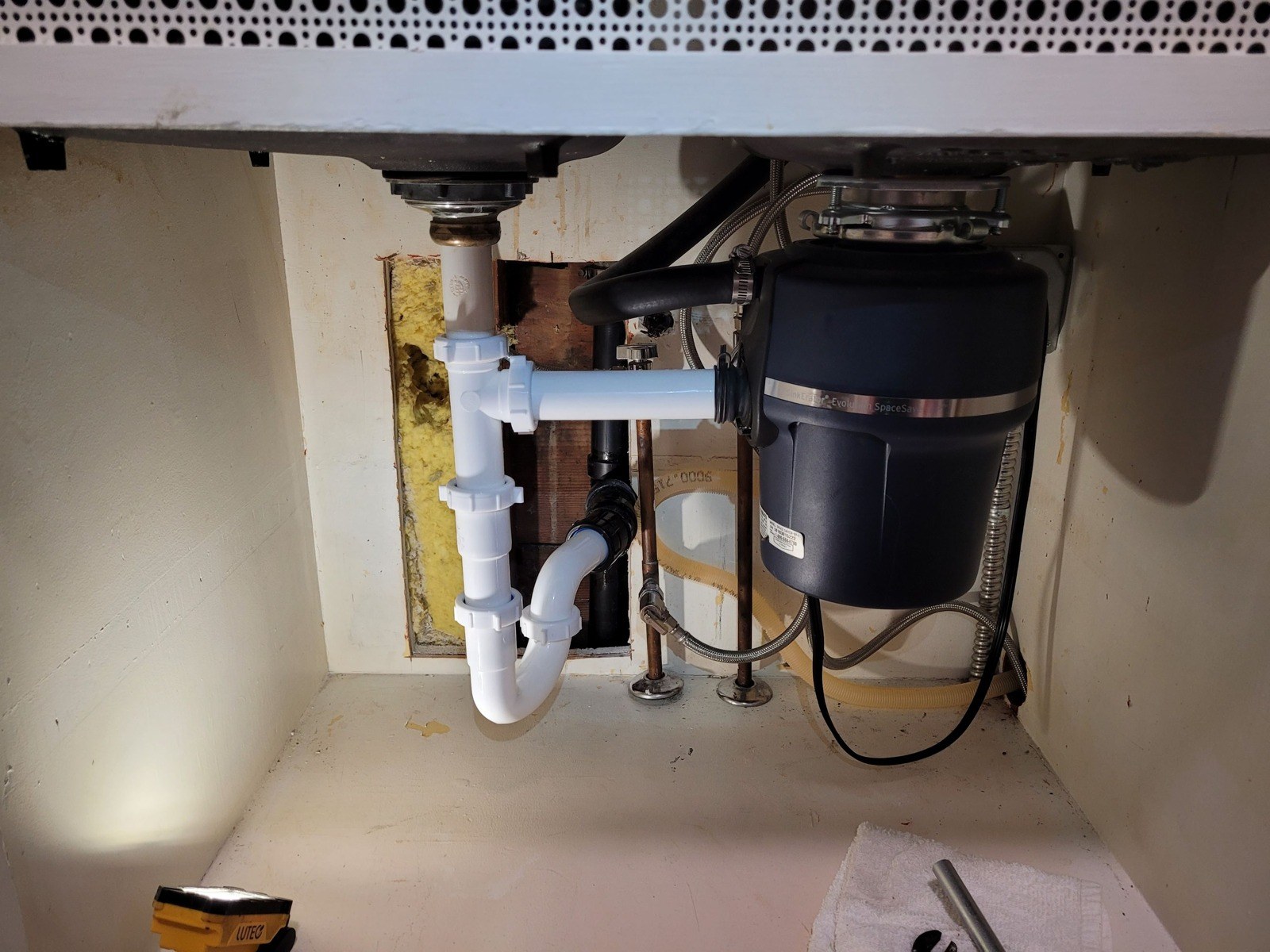
Every galvanized joint is a thread cut into the pipe wall, and cutting threads removes a good part of the wall thickness right at the joint. The zinc coating that gives galvanized pipe its name is thinnest there too, so that is where the steel underneath starts rusting first. A short nipple between two cast-iron fittings is all threads and no body. In December Logan opened the cabinet wall behind a kitchen sink in Northwest Everett and found exactly that: the galvanized nipple between a cast tee and a cast 90 had rotted through while both fittings were intact. He cut the failed section out, rebuilt it in ABS, and ran three dump tests before the wall was closed.
2. Drain side and supply side announce themselves differently
On the drain side the symptom is water where it should not be: rust weeping at the slip joints under a sink, a cabinet floor that stays damp, a crawl space that smells of wash water. In February, under a rental unit behind a north Everett storefront, Logan found a 1½-inch galvanized nipple at a wye that had eroded through along its bottom, sending every shower into the crawl. He unspun what was left of it from the wye and rebuilt the run in ABS, then fixed a shower drain that had dropped off its fitting while he was under there.
On the supply side the pipe announces itself at the tap: rusty water on the hot side first, a trickle at a fixture that used to run full, and threads that crumble when something new is screwed onto them. In March a Boulevard Bluffs homeowner threaded a new angle stop onto an old galvanized supply nipple under a sink, and the threads collapsed as it went on. Logan and Willie replaced the nipple and the stop together, which is the only fix for that one.
3. What Everett's water does to it
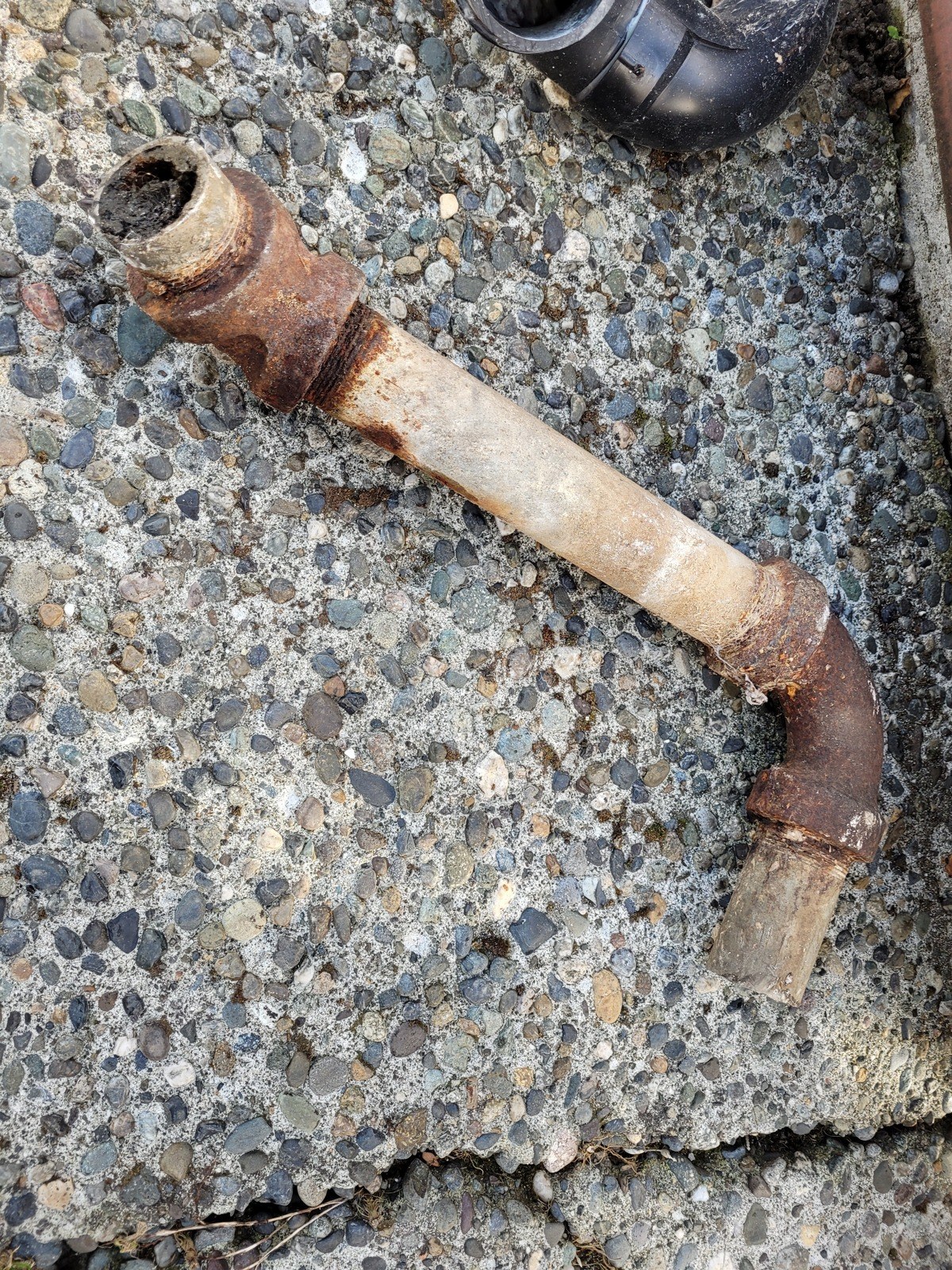
Everett's water comes from Spada Reservoir at the head of the Sultan River and is filtered near Chaplain Reservoir before it reaches the city. It is very soft. The 2025 water quality report from Alderwood Water & Wastewater District, which buys Everett's water, lists total hardness between 10 and 16 parts per million as calcium carbonate, well under one grain per gallon, with alkalinity between 13 and 26. Soft, low-alkalinity water does not lay down the mineral scale that, in harder-water cities, coats the inside of a steel pipe and slows the attack on it. Everett holds the pH of its water at 7.4 or above under a state-required corrosion control program aimed at lead and copper, but no treatment can put zinc back on a pipe that has lost it, and once the zinc is gone the steel rusts from the inside out. Rust takes up more room than the steel it replaces, so the bore closes from the bottom up, which is why the nipple in the photo at the top of this page is nearly shut.
4. Why the north end
Rucker Hill was laid out from about 1900 and built up over the next thirty years, and the grid around it, Northwest Everett, Bayside and Riverside, went up in the same decades. Galvanized steel was the standard supply and branch-drain pipe for that whole era, and in a house that has stood since the Rucker mansion went up in 1904, the pipe behind the plaster is on its third or fourth generation of repairs. Every one of those repairs is a new thread cut into old pipe, and every one is a future leak, which is why the galvanized jobs in our records cluster on the north end.
5. The spot repair: cut back to sound metal
The right repair is not to unscrew the failed piece and screw in a new one, because the threads on the old fitting are as tired as the nipple that just failed. In September, in Riverside, Logan traced a kitchen leak to a galvanized waste line in the wall, cut the failed section out, kept cutting until the pipe he was joining to was sound, and rebuilt from there in ABS with a proper transition coupling before running three dump tests. Under that sink sat a large bottle of drain cleaner, which is worth a word: caustic cleaner poured into a pipe that is already rusting through does not clear it, it finishes it.
6. When a spot repair stops making sense
Three signs. The first is the second call: once two nipples in the same run have failed, the rest of that run is the same age and the same metal. The second is rusty hot water at more than one fixture, because that is the supply side telling you the bore is closing everywhere at once, not in one place. The third is pressure that drops when a second tap opens, in a house whose pressure at the meter is fine. At that point the honest recommendation is a repipe of that branch or of the house, in PEX or copper, and we say so rather than sell a fourth patch.
Our Recommendation
Fix the failed nipple now and fix it properly, cut back to sound pipe with the right transition, because a leak under a north-end house does damage every day it runs. Then plan the repipe by branch, starting with whichever run has failed twice, and never put drain cleaner into a galvanized line. Our water leak repair page covers what a repipe involves, and a hose bib on a galvanized stub is a small version of the same job, which we cover on the Everett hose bib page.
Galvanized Questions From North Everett
How can I tell whether my Everett house still has galvanized pipe?
Look at the pipe where it is exposed, under a sink or in the basement. Galvanized is grey, threaded at every joint, and a magnet sticks to it; copper is orange or green and soldered, and PEX is plastic. A north-end house built before 1960 that has not been repiped almost certainly has some, usually at the fixtures.
Can you replace just the bad section?
Yes, usually. We cut out the failed nipple or stub, keep cutting until the pipe is sound, and rebuild that section in ABS on the drain side or copper or PEX on the supply side, with a transition fitting made for joining new pipe to old steel. The rest of the run is left alone until it earns a repair.
Does Everett's soft water make galvanized last longer or shorter?
Shorter, most likely. Hard water coats the inside of steel pipe with scale that slows corrosion, and Everett's Spada Lake water is too soft to do that, so once the zinc is gone the steel is unprotected. The city's pH treatment helps, but the north-end galvanized we cut out is typically rusted from the inside with the bore half closed.
A Leak Under an Old Everett House? Call and tell us where the water is showing up. If it is a north-end house we will bring the fittings for galvanized, and we will tell you honestly whether this one is a patch or the start of a plan. Related: water leak repair and repipes · plumbing in Everett · hose bib repair in Everett · a main drain failure under a south Everett rental · drain cleaning